Southern Kruger is the most popular section of the Kruger National Park and the best choice for first-time visitors, with the highest concentration and diversity of wildlife in the park.
That isn't marketing. It's geography. The south has two perennial rivers, the Sabie and the Crocodile, which means water flows here year-round, even when the rest of the park dries out. Water attracts animals. Animals attract predators. And the whole system creates the kind of game viewing density that the central and northern sections simply can't match consistently.
The south is also the most accessible section. If you're driving from Johannesburg or Pretoria, you're looking at roughly five to six hours on the N4 to Nelspruit before turning toward whichever gate you've chosen. If you're flying, Kruger Mpumalanga International Airport (KMIA) near Nelspruit puts you within an hour of the nearest southern gate. There's also Skukuza Airport inside the park itself, though flight options are more limited.
But popularity has a trade-off. Southern Kruger is busier than the rest of the park, particularly during school holidays and long weekends. If you're imagining an empty road with a lion to yourself, that's more likely in the central or northern sections. What the south gives you is reliability: the best odds of ticking off the Big Five, the shortest distances between rest camps, and the most developed facilities in the park.
Here's everything you need to decide whether the south is right for your trip, which camp to book, which gate to use, and what to expect when you get there.
Which gate should you use?
Southern Kruger has five entrance gates. The right one depends on where you're coming from and where you're staying.
Malelane Gate is the most direct entry point if you're driving from Johannesburg via the N4. It's the closest gate to Berg-en-Dal rest camp, roughly 25 minutes' drive inside the park. The gate can get congested at peak times, so arriving early matters, especially during school holidays.
Crocodile Bridge Gate serves visitors coming from Marloth Park (about a 20-minute drive) or Komatipoort (around 12 minutes). The gate doubles as a small rest camp. The surrounding area is rich with game, but be warned: waits of up to two hours have been reported during peak periods. If you're entering here, be at the gate before it opens.
Paul Kruger Gate is the most well-known entrance, named after the former president who established the original Sabie Game Reserve. It's the natural entry point from Hazyview or White River, and puts you roughly 12 minutes from Skukuza, the park's largest camp. The access road is well-maintained and considered safe.
Phabeni Gate is a newer, quieter alternative to Paul Kruger Gate, also accessed from Hazyview. Built in 2002, it's less busy and puts you about 25 minutes from Skukuza. If you're staying in Hazyview, this is often the smarter choice. Less queuing, same section of the park.
Numbi Gate provides the quickest access to Pretoriuskop camp, but the access road has ongoing safety concerns. Both the Kruger Gate Hotel and experienced local visitors actively advise against using it. Use Paul Kruger or Phabeni instead.
All gates open at sunrise and close at sunset, with exact times varying by month. SANParks publishes the schedule and updates it, so check before you travel. Being late isn't a minor inconvenience. You will be fined, and if you arrive after 21:00, you'll be refused entry entirely. Plan to be back at your camp or gate at least 15 minutes before closing time.
What wildlife will you see?
Southern Kruger is the most reliable area in the park for Big Five sightings, but “reliable” doesn't mean “guaranteed.” Wildlife is wild. What you can count on is that the density here gives you the best odds.
Rhino sightings are strongest in the area around Berg-en-Dal and the southwestern part of the park. Many of the rhinos you'll see have been dehorned as a poaching deterrent. It can look strange at first, but it's a conservation measure that's keeping them alive.
Leopard sightings are most likely along the Sabie River corridor, particularly on the road between Skukuza and Lower Sabie. That stretch, the H4-1, is widely considered the best single game drive in the entire Kruger National Park, and leopard is the main reason why. The riverine forest along the Sabie provides perfect habitat: dense cover, large trees, and prey animals coming to drink.
Lion prides are present throughout the south, though if big cats are your primary focus, the open grasslands of central Kruger around Satara are actually more productive for lion sightings. In the south, you're more likely to spot them along river roads and near larger dams.
Elephant and buffalo move in large herds near both rivers. You'll almost certainly see them. Hippo and crocodile are just as reliable. Both perennial rivers are home to healthy populations, and viewpoints along the Sabie River near Lower Sabie are particularly good.
Beyond the Big Five, the south delivers well. Cheetah are seen in the more open areas around Crocodile Bridge. Wild dog, among the most endangered large predators in Africa, are increasingly spotted around Berg-en-Dal and the southeastern part of the park. Giraffe, zebra, wildebeest, kudu, and impala are everywhere. Birdlife is prolific, especially during the wet season when migratory species arrive.
Seasonal differences matter. During the dry season (May to September), vegetation thins out and animals concentrate around remaining water sources. This makes them far easier to spot, and it's the most popular time to visit. During the wet season (November to March), the bush is thick and green, animals are dispersed, and spotting game takes more patience. The birdlife is exceptional, though, and the landscape is beautiful. The shoulder months of April and October often offer the best balance: fewer crowds, reasonable game viewing, and moderate temperatures.
Rest camps compared: An honest guide
This is the part most guides get wrong. They either list every camp without helping you choose, or they tell you about one person's experience and leave you guessing. Here's a straight comparison of every rest camp in southern Kruger, including the things other guides won't tell you.
Skukuza
Skukuza is the largest rest camp in Kruger National Park, with accommodation for over 800 visitors, multiple restaurants, a well-stocked shop, an ATM, a petrol station, a laundromat, and even a golf course.
It's also the camp that divides opinion most sharply.
The facilities are unmatched anywhere else in the park. The Cattle Baron restaurant is the best sit-down meal you'll get in Kruger. The location on the Sabie River is beautiful, and the game viewing in the surrounding area is excellent. Lake Panic bird hide is a short drive away, and the roads heading east toward Lower Sabie are some of the park's best.
But Skukuza doesn't feel like the bush. It feels like a small town that happens to be inside a national park. During school holidays, the day-visitor area heaves with activity, and any good sighting nearby will have a traffic jam of vehicles. If your idea of a safari includes silence and solitude, Skukuza will test your patience.
Best for: Visitors who want the best facilities, families with young children who need a safety net of restaurants and shops, anyone arriving late who needs a camp close to Paul Kruger Gate.
Not ideal for: People seeking a quiet bush experience, anyone who dislikes crowds, repeat visitors looking for something different.
Lower Sabie
Lower Sabie is the most popular rest camp in southern Kruger and typically books out 11 months in advance.
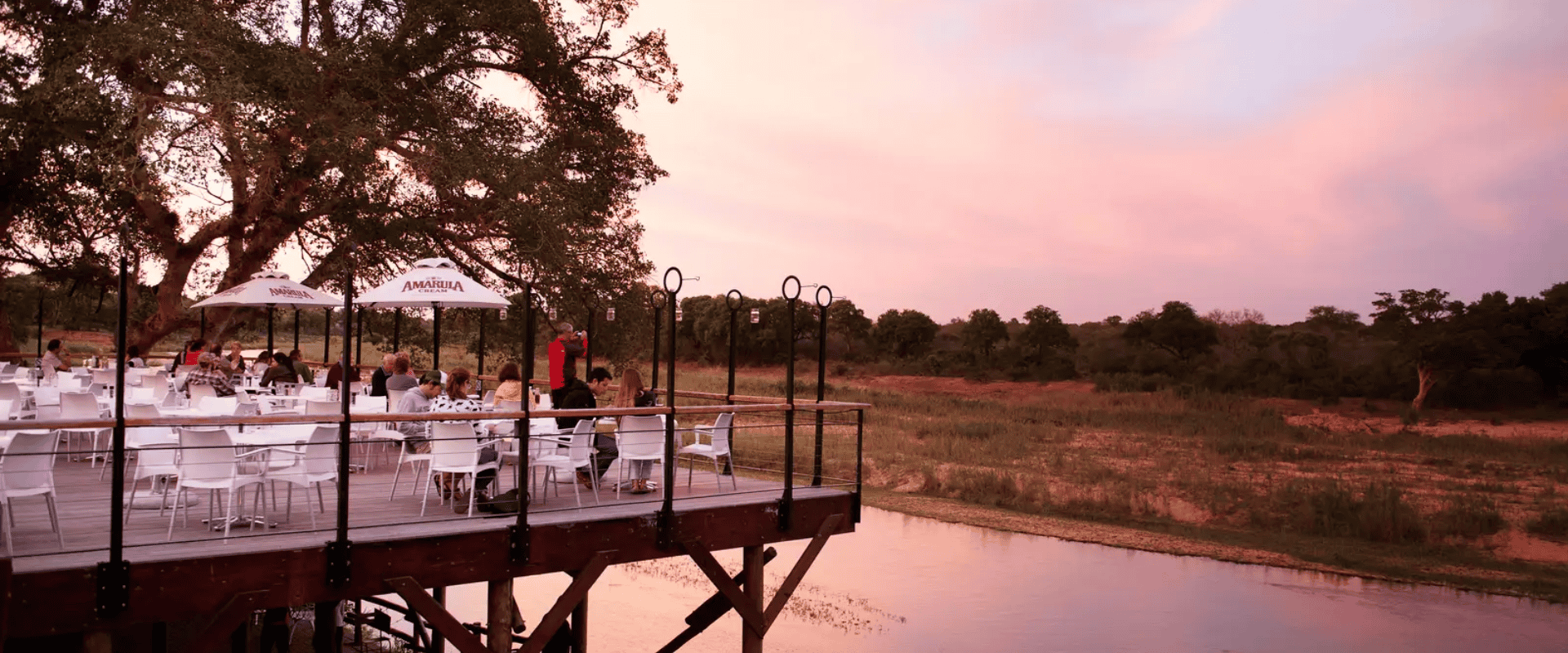
There's a reason for that. The camp sits on the Sabie River with a restaurant deck that overlooks the water. You can have a glass of wine and watch buffalo graze at the same time. It has a Mug & Bean with WiFi (rare in Kruger), decent shops, and a petrol station. It's large enough to have proper facilities but small enough to feel calmer than Skukuza.
The safari tents along the river are the most sought-after accommodation in the entire park. If you can get one, book it.
Game viewing around Lower Sabie is consistently excellent. Sunset Dam, just outside the camp, is one of the most reliable wildlife-viewing spots in the park. The road south toward Crocodile Bridge and the road west toward Skukuza are both productive drives.
Best for: First-time visitors who want the classic southern Kruger experience, couples, anyone willing to book far in advance.
Not ideal for: Last-minute planners (it will be full), visitors on a tight budget (the best units are priced accordingly).
Berg-en-Dal
Berg-en-Dal is the underrated camp that most experienced Kruger visitors quietly prefer.
It's set in hilly terrain among large trees on the bank of the Matjulu Spruit. Arguably the prettiest setting of any camp in the south. The brick bungalows aren't as photogenic as Lower Sabie's riverside tents, which is partly why it gets overlooked. But the camp is well-maintained, the internal nature trail is excellent (especially at dusk with a torch, listening for lions beyond the fence), and the swimming pool has a view.
The area around Berg-en-Dal is the best in southern Kruger for rhino sightings. Wild dog are increasingly seen here too. Bush walks departing from the camp are highly rated by visitors. The terrain is more varied than around the river camps, and the guides share detailed knowledge about the smaller things most self-drivers miss entirely.
Berg-en-Dal often has availability when every other southern camp is booked out. This isn't because anything is wrong with it. It's because it has fewer roads in and out (just one tar and one gravel), which means traffic can bottleneck at sightings, and it takes slightly longer to reach the “hotspot” areas around Lower Sabie and Skukuza. For visitors willing to get up early and drive, that's a non-issue.
Best for: Repeat visitors, rhino enthusiasts, bush walk fans, anyone booking last-minute who finds everywhere else full.
Not ideal for: Visitors who want to be on the Sabie River, anyone who wants restaurant dining with a river view.
Crocodile Bridge
Crocodile Bridge is one of the smallest camps in the park, sitting right at the gate of the same name on the southern boundary. It's basic. Think clean accommodation and a small shop, not restaurants and swimming pools.
What it lacks in facilities, it makes up for in game viewing. The area around Crocodile Bridge has dense lion and rhino populations, and the drive north toward Lower Sabie passes through productive cheetah and wild dog territory. It's also the natural entry point for anyone staying in Marloth Park or Komatipoort, and for visitors heading to or from Mozambique.
Best for: Budget-conscious visitors, anyone using Marloth Park as a base, people who prioritise game viewing over camp comfort.
Not ideal for: Visitors wanting full camp facilities, families who need a pool and restaurant.
Pretoriuskop
Pretoriuskop is the oldest camp in Kruger and one of the quietest in the south. The vegetation here is different: sourveld with longer grass and denser bush, which means game viewing requires more patience. You won't see the same open-savanna herds as around Satara or even Lower Sabie.
What Pretoriuskop does offer is leopard, elephant, buffalo, and a range of antelope species. The camp has a Wimpy (make of that what you will), a pool, and a distinctly old-school Kruger feel. It's also the closest camp to Numbi Gate, though as noted, that gate isn't recommended.
Best for: Visitors who want quiet over spectacle, those interested in different vegetation and birdlife, budget-friendly stays.
Not ideal for: First-time visitors wanting maximum Big Five action, anyone who wants to be near the Sabie River game drives.
Biyamiti Bush Camp
Biyamiti is a small self-catering bush camp with just 15 cottages, tucked away on the Mbiyamiti River. There's no restaurant, no shop, and no petrol. What there is: genuine quiet, birdsong, and a feeling of being properly in the bush that the main rest camps can't replicate.
Because it's small, it books out fast. And because it's self-catering only, you need to arrive with everything you need. Stock up at Skukuza or outside the park before heading in.
Best for: Repeat visitors craving solitude, self-sufficient travellers, couples.
Not ideal for: First-time visitors (you'll want facilities while you learn the park), families with young children, anyone uncomfortable with genuine remoteness.
Best driving routes in southern Kruger
You don't need to drive every road. These are the ones that earn their reputation.
The Sabie River road (H4-1, Skukuza to Lower Sabie) is the single best game drive in southern Kruger. It follows the Sabie River through dense riverine forest, prime leopard habitat, with regular sightings of elephant, buffalo, hippo, and a wide range of birds. Allow at least two to three hours each way, more if you stop often. Early morning or late afternoon gives the best predator activity.
The southern triangle (Berg-en-Dal to Crocodile Bridge to Lower Sabie) is a full-day circuit that covers the most diverse terrain in the south. You'll pass through rhino country near Berg-en-Dal, open areas near Crocodile Bridge where cheetah and wild dog are seen, and then the Sabie River corridor as you approach Lower Sabie. Pack food and water. This is a long drive with limited stop points.
The S28 loop south of Lower Sabie is a shorter gravel road that's reliable for predator sightings, particularly in the late afternoon when cats start moving. It's less busy than the main tar roads and worth including in a Lower Sabie-based itinerary.
Lake Panic bird hide is a short detour off the H11 near Skukuza. Even if you're not a dedicated birder, it's worth a stop. The hide overlooks a small dam surrounded by mature trees, and it's one of the few places in the park where you can get out of your car and sit quietly in the bush. Often surprisingly empty.
Nkhulu picnic site, on the Sabie River between Skukuza and Lower Sabie, is the best lunch stop in the south. It's solar-powered with good facilities, clean ablutions, and a lovely river setting. Well worth building into your H4-1 drive.
When to visit
Dry season (May to September) is the most popular time and for good reason. Vegetation is thinner, animals gather at water sources, and visibility is at its best. Mornings are cold, so you'll want layers for an early game drive, but days are mild and clear. This is when you'll find the most competition for accommodation and the busiest roads.
Wet season (November to March) transforms the landscape. Everything is green, the birdlife explodes with migratory species, and if you time it right, you'll see newborn animals. But the thick bush makes spotting game genuinely harder, it's hot and humid, and afternoon thunderstorms are common. Some gravel roads may close temporarily after heavy rain.
Shoulder months (April and October) are often the sweet spot. April still has decent water levels so game hasn't fully concentrated yet, but the bush is starting to thin. October is dry and hot, but the first rains are approaching and migratory birds begin arriving. Both months have fewer visitors and lower accommodation prices than peak season.
Who southern Kruger suits
Book in the south if you are:
A first-time Kruger visitor who wants the best chance of seeing the Big Five. A family with children who'll benefit from camp swimming pools, restaurants, and shorter driving distances. A self-driver who wants a dense road network and frequent rest stops. Someone driving from Johannesburg or Pretoria who wants the most direct access to the park.
Consider central Kruger if:
Big cats are your priority. The open grasslands around Satara are better for lion and cheetah. You've done the south before and want a different landscape. You prefer fewer tourists and wider horizons.
Consider staying outside the park if:
You want accommodation that's more luxurious or spacious than what the rest camps offer. You prefer the flexibility of not being bound by gate times. You want proper restaurant options, reliable connectivity, and the feel of a town nearby.
If that's you, look at Hazyview (15 km from Phabeni Gate, full town amenities, Panorama Route access), Marloth Park (a wildlife conservancy 20 minutes from Crocodile Bridge, animals on your doorstep, self-catering focused), or Hoedspruit (gateway to the Greater Kruger private reserves like Timbavati and Klaserie, best for fly-in visitors).
Practical tips
Fuel is available at Skukuza, Lower Sabie, and Berg-en-Dal. Fill up before long drives. There are no stations between camps.
Speed limits are 50 km/h on tar roads and 40 km/h on gravel. That's not a suggestion. SANParks enforces it, and you'll miss half the animals at anything faster anyway.
No alcohol is allowed for day visitors entering the park. Overnight visitors can bring their own.
Check-in is from 14:00, check-out by 10:00. Camp gates have separate closing times from park entrance gates, so know both.
Cell signal is reliable at main camps in the south and patchy between them. Don't rely on your phone for navigation deep in the park. The Kruger National Park Guide and Map by Andy and Lorrain Tinker is the best investment you'll make. Available at most rest camp shops.
Book guided activities at camp reception. Morning bush walks are the most underrated experience in Kruger. A ranger takes you on foot into the bush before sunrise, and you learn more in two hours than in a week of self-driving. Night drives are also worthwhile for seeing nocturnal species you'll never spot from your own car during the day.
Conservation fees apply for every day spent in the park. South African residents pay a discounted rate with a valid ID. SADC nationals qualify for a separate rate with a passport. International visitors pay the standard rate. Fees are payable at the gate or can be covered by a Wild Card annual pass, which pays for itself in roughly three visits.
Book early. This bears repeating. Lower Sabie books out 11 months in advance. Biyamiti and the popular safari tents go fast. If you know your dates, book the day the window opens. If you're planning last-minute, Berg-en-Dal and Pretoriuskop are your best bets for availability, and Crocodile Bridge sometimes has openings too.
 Luxury Safari Lodges
Big 5
Luxury Safari Lodges
Big 5